The Best Digital Product Design Agencies to Choose in 2026–2027

Choosing a digital product design agency is one of those decisions that looks straightforward until you are actually making it.
The numbers behind bad choices are sobering. Studies consistently show that 70-90% of digital products fail to meet their initial business objectives — and poor design decisions are among the top contributing factors, alongside unclear product strategy and misaligned user research. McKinsey's research found that companies in the top quartile of design performance outperform industry benchmarks by up to 32% in revenue growth. Forrester has put the ROI of good UX at 9,900% in some enterprise contexts — every dollar invested returning up to $100 in business value.
The gap between those numbers and average outcomes isn't a resources problem. Most companies spend enough on product design. It's a vendor selection problem. Every agency has a polished portfolio, a list of recognizable clients, and a deck that explains their process in language that sounds identical to every other agency's deck. The real differences — how they handle ambiguity, whether they push back on bad briefs, what happens when the research contradicts what the client believes — don't show up until you're already in an engagement.
This list focuses on digital product design agencies that have demonstrated the thing that matters most: the ability to connect design decisions to business outcomes that clients can actually measure and to produce work that performs.
Linkup ST
Website: linkupst.com
Location: New York, NY
Focus: Product Design, UI/UX Design, Conversion & UX Optimization
Best for: Companies needing digital product design that connects every decision to measurable business outcomes
Linkup ST operates through a proprietary emotional-functional framework that runs two parallel tracks through every digital product design engagement. The functional track ties every design decision to specific OKRs and metrics (e.g., activation rate, feature adoption, time-to-value, and conversion). The emotional track considers how users experience the product across visceral, behavioral, and reflective levels simultaneously. For digital products specifically, that reflective level — whether the product feels trustworthy and makes the user feel more capable — is often what determines long-term retention rather than just initial adoption.
Key differentiator: An emotional-functional framework connecting every digital product design decision to specific business metrics

Lazarev.Agency
Website: lazarev.agency
Location: San Francisco, CA
Focus: Digital product design, AI products, B2B SaaS, startup design
Best for: Digital product companies at growth stage needing design that supports both user adoption and commercial outcomes
Lazarev has built their practice around the commercial dimension of digital product design — the understanding that good product design needs to work for investors and enterprise buyers as much as for end users. Their track record includes $500M raised for clients through design work that strengthens fundraising materials and product positioning alongside the user experience. AI practice active since 2018. 120+ design awards including five Webby Awards and six Red Dot Awards.
Key differentiator: Digital product design with focus on AI and complex B2B projects
Cieden
Website: cieden.com
Location: Europe / North America
Focus: B2B SaaS digital product design, AI UX, enterprise products
Best for: Companies building complex B2B digital products where adoption within existing workflows is the core design challenge
Among top product design agencies with genuine B2B depth, Cieden stands out for their specific focus on the adoption problem — designing digital products that professional users actually integrate into their workflows rather than tolerate and work around. Their public research on AI UX patterns and 200+ completed projects across healthcare, fintech, and edtech reflect accumulated expertise rather than general design capability applied to enterprise contexts.
Key differentiator: B2B digital product design depth — adoption within existing professional workflows rather than disruption of them
Work & Co
Website: work.co
Location: Brooklyn, NY
Focus: Digital product design and development
Best for: Companies needing digital product design and implementation under one engagement
Work & Co is consistently cited among the strongest best product design firms globally — and their commitment to staying involved through implementation is what earns that reputation. The interaction details that determine whether a digital product feels trustworthy and well-built don't survive handoffs between separate design and engineering teams. Work & Co owns the full process. Client list includes Apple, Google, and Virgin America.
Key differentiator: Digital product design through implementation — the product that ships matches what was designed
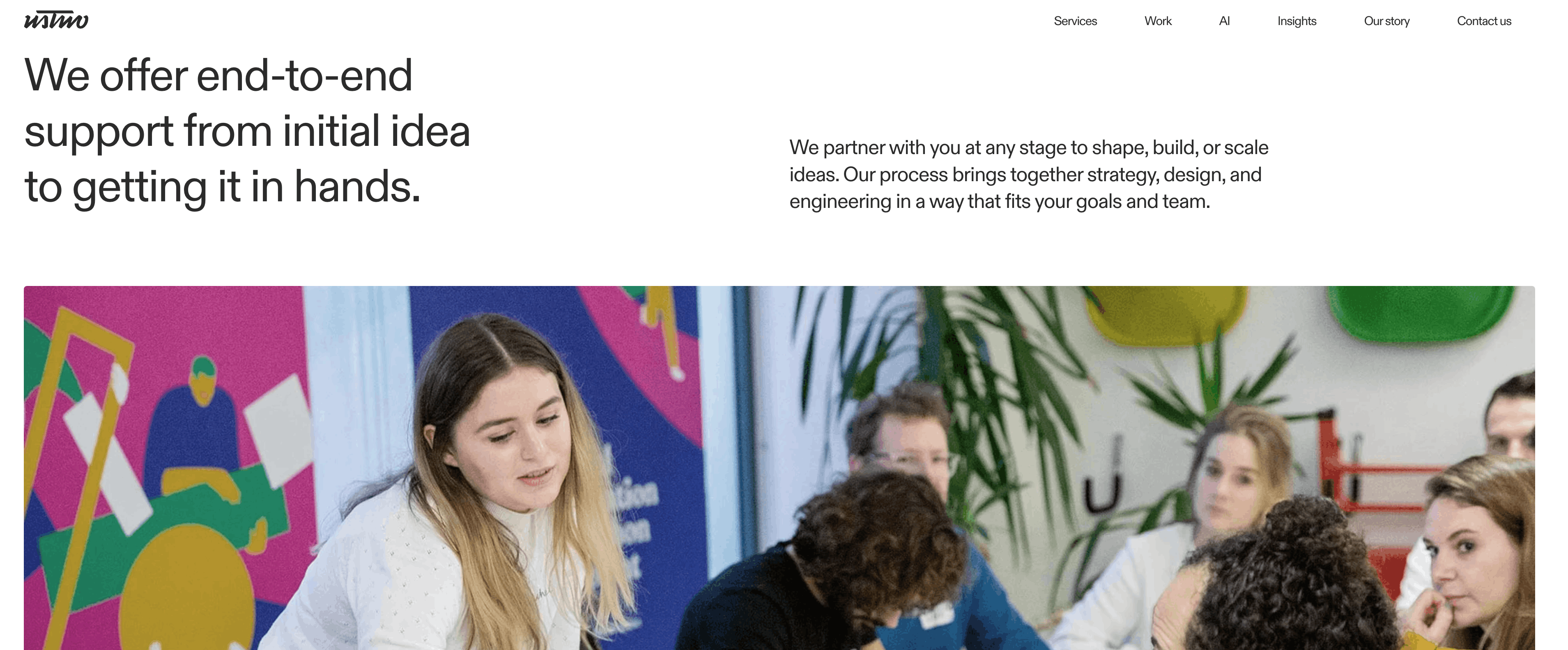
Ustwo
Website: ustwo.com
Location: London / New York
Focus: Digital product design, venture building
Best for: Companies at the product definition stage that need strategic input before design execution begins
Ustwo engages upstream — in product definition and strategic framing before the design brief is written. For companies that haven't fully defined what they're building or how to differentiate it in a crowded market, their pre-design strategic work reduces the expensive risk of executing the wrong direction with high craft. Their venture building practice means they think about product-market fit alongside the interface.
Key differentiator: Pre-design strategic input for digital products — defines what to build before committing to how it works
Clay
Website: clay.global
Location: San Francisco, CA
Focus: UI/UX and brand design for technology companies
Best for: Digital product companies where visual credibility is a primary conversion lever
Clay's visual quality for technology products is among the highest available — Meta, Slack, Google. For digital product companies where the visual impression of the product affects whether enterprise buyers take it seriously during evaluation, their premium visual layer creates a credibility signal that most product design firms don't prioritize to the same degree. Strong at brand-to-product coherence where consistent visual quality reinforces product credibility across every touchpoint.
Key differentiator: Premium visual quality for digital products where first impression drives enterprise conversion
Huge
Website: hugeinc.com
Location: New York, NY (multiple offices)
Focus: Digital experience design for enterprise
Best for: Large enterprises deploying digital product design across complex multi-product environments
Huge has the organizational infrastructure for large-scale digital product design programs — large teams, complex multi-product program management, enterprise-grade governance. For large organizations that need to roll out digital product design across multiple products and business units simultaneously, their scale handles scope that boutique agencies can't accommodate. Deep vertical experience in financial services, media, and retail.
Key differentiator: Enterprise-scale digital product design infrastructure for multi-product organizational programs
UX Design vs. Product Design: What's Actually Different
These terms get used interchangeably often enough that the distinction feels academic. It isn't — especially when you're choosing an agency and trying to scope what you actually need.
UX design is a discipline within product design. It focuses specifically on the user experience layer — how people interact with a product, how they navigate it, where they encounter friction, how the interface communicates what's happening. Good UX design is grounded in research, tested with real users, and evaluated against usability metrics. It's the part of product design most people think of when they think of design.
Product design is broader. It encompasses UX but also includes the strategic and business dimensions of how a product gets shaped. A product designer isn't just asking "is this interaction clear?" — they're asking "should this feature exist at all, who is it for, how does it connect to the business model, and what does success look like six months after launch?" Product design is the discipline that sits at the intersection of user needs, business objectives, and technical constraints.
The practical difference shows up in how agencies engage. A UX-focused engagement typically starts with an existing product or defined scope — the problem is known, the goal is to improve how the product communicates with users. A product design engagement often starts earlier — at the point where the product direction is still being defined, where the question isn't just "how do we design this" but "what should we be designing and why."
For digital products specifically, this distinction matters because the most expensive design mistakes happen before the interface is designed at all. Building the wrong product beautifully is a product design failure, not a UX failure — and it requires product design thinking to catch, not just usability research.
Most of the agencies on this list do both. What varies is where they're strongest. Some are primarily UX agencies that have expanded into broader product design work. Others are product design firms in the full sense — starting upstream, engaging with strategy and definition before touching visual or interaction design. Understanding which you need changes which agency you should hire.
The clearest signal: if you know what you're building and need help making it work well for users, UX depth is the primary filter. If you're still figuring out what to build or whether the current direction is right, product design depth — specifically the strategic and research capability that informs product decisions — is what matters most.
How to Choose Digital Product Design Agencies
Define the product problem before the design brief
The agencies that produce the best digital product design outcomes don't start with visual direction — they start with the problem the product needs to solve for specific users in specific contexts. Before briefing any agency, define what success looks like in measurable terms: which users, doing what, with what outcome, measured how. That definition determines what good design actually means for your product. Agencies that engage seriously with that definition before proposing solutions are the ones worth evaluating further.
Evaluate their approach to business outcomes alongside user experience
The best digital product design agencies understand that design serves the business as much as it serves the user. Activation rates, feature adoption, enterprise conversion, support ticket reduction — these are the metrics that connect digital product design to the outcomes companies care about. Ask specifically how agencies define and measure design success. The specificity of the answer tells you whether you're talking to a firm that thinks about design quality or design outcomes.
Look for research depth before design depth
Beautiful digital product design built on poor research produces products that work in demos and fail in real user workflows. Ask how agencies approach user research — what methods they use, how findings shape design decisions, how they handle cases where research contradicts what the client believes. Agencies with genuine research depth have worked through these tensions. Those without give vague answers about being user-centered.
Consider the ongoing engagement model
Digital products aren't finished at launch. They evolve as user behavior data accumulates, as competitive dynamics shift, as new capabilities become possible. The right digital product design agency is structured for ongoing engagement alongside product development — not periodic redesigns that happen after the product has already shipped without design input. Ask how agencies structure ongoing design partnerships and what the embedded model looks like in practice.
Match agency scale to your actual needs
New York and San Francisco agencies with large teams and enterprise clients aren't automatically better for every digital product design need. Match scale to scope: boutique agencies give you direct senior access throughout the engagement, which matters for design-intensive products where the decisions are nuanced and fast. Large agencies give you depth of specialization and delivery capacity for complex programs. Be honest about what your product actually requires.
Look at outcome evidence alongside portfolio quality
Portfolio quality is table stakes in digital product design. What distinguishes the agencies worth hiring is documented outcomes — adoption rates that improved, conversion that increased, enterprise deals that closed because of the product experience, user retention that changed because of design decisions. Ask specifically for outcome evidence from past digital product design engagements. That evidence tells you whether the agency produces good-looking work or good-performing products.
.avif)