Leading AI Designers Shaping the Future of Product Design

AI businesses have a design problem that general design agencies aren't built to solve. It's not a UI problem — it's a trust problem wearing a UI. The product has to feel credible to enterprise buyers before they've seen a single demo. The interface has to earn trust from users who are skeptical of AI outputs by default, not curious about them. Onboarding has to work for people who've never used anything like this before and didn't necessarily ask for it. And because AI products keep changing after launch — the model shifts, outputs drift, new failure modes surface in production that never showed up in testing — the design work doesn't stop when the product ships.
That's what makes AI businesses different from most software: the interface isn't just how the product works, it's how the product argues for itself. Every screen is either building the case that this AI is reliable enough to trust with something real, or quietly undermining it. Get that wrong and no amount of downstream sales or marketing work fully compensates — because in AI businesses specifically, the product experience is doing a lot of the sales team's job before a rep ever gets on a call.
Most designers can talk about AI in the abstract. Far fewer have actually sat with the harder version of the problem: what the interface owes the user when the model is wrong, how much to explain versus just act, what "trustworthy" looks like to a procurement team versus a first-time user. That gap is wide enough that "has designed something with AI in it" and "understands how to design for AI" are often two different people. This directory focuses on the second group — designers with real AI business project experience, not just AI-adjacent portfolio pieces.
Nataliya Sambir
Years of experience: 12
Primary focus: UX, Conversion Optimization, Emotional Design
Key services: UI/UX Design, Product Design, UX Consulting
Location: Europe
AI businesses need design that converts skeptical buyers and builds trust with reluctant users simultaneously. That's the specific problem Nataliya's practice is built around. Her Emotional-Functional Framework runs two tracks: OKR-driven functional design where every decision connects to a metric, and emotional design that works across visceral, behavioral, and reflective experience layers. For an AI business, that reflective layer — does this product feel like it understands my problem, does it feel like something I'd trust with real decisions — is often what determines whether enterprise deals close.
Twelve years of practice. Work that's reached 70M+ users. 40+ global recognitions including Red Dot, Webby, and Apple. The kind of ai graphic designer who treats conversion as a design outcome, not a marketing afterthought.
Pavlo Savchenko
Years of experience: 8
Primary focus: UI/UX
Key services: Conversion Optimization, UI/UX Design, Product Design, UI/UX Audit
Location: Ukraine
AI businesses rarely fail because the model is bad. They fail because users don't understand what the product is doing, don't trust the outputs, or can't figure out how to integrate it into their workflow. Pavlo's ai design services are specifically oriented toward finding and fixing those failure points — through structured audits, conversion optimization, and ongoing iteration tied to specific business metrics.
Eight years at Linkup ST. The performance model he operates within embeds him in client workflows on an ongoing basis, which matters for AI businesses where the product keeps evolving as the model does. Design as a continuous business function, not a one-time delivery.

Darya Ebadian
Years of experience: 5+
Primary focus: UI/UX Design, Product Design
Key services: UI/UX Design, Product Design, Mobile App Design, UI/UX Audit
Location: Ukraine
Darya leads UI/UX at Linkup ST across web, mobile, and product design. For AI business projects specifically, her strength is in the translation layer — taking complex AI capabilities and making them feel approachable and credible to users who didn't ask for AI and aren't sure they want it.
Her background spans Lynksen, Dodotap, and Artman Studio before Linkup ST, building breadth across product types and user contexts. She works within the Emotional-Functional Framework, which means visual decisions get evaluated against measurable business outcomes rather than aesthetic judgment alone.
Ben Shih
Years of experience: 7+
Primary focus: AI Product Design, Growth Design
Key services: AI Feature Design, Onboarding Design, Product Growth, Conversion Optimization
Location: Amsterdam, Netherlands
Ben is the kind of designer AI businesses need when the core challenge is adoption. His background in data science means he approaches AI product design as a systems problem — not just how does this look, but how does this behavior get communicated, how does trust get built through the interaction pattern, how does the product get users to a moment of genuine value before they give up.
At Miro, he redesigned how AI surfaces to new users across the product. At Lokalise, he built an AI-first translation review system that replaced a spreadsheet-heavy manual process — which is exactly the pattern most B2B AI businesses are trying to execute. Available for consulting.
Andrii Hadai
Years of experience: 15
Primary focus: AI Product Design, Creative Direction
Key services: UI/UX Design, Creative Direction, AI Product Interfaces, Design Systems
Location: United States
Fifteen years of design practice, currently running the department at Lazarev.Agency — an agency that's been doing AI product design since 2018, before most agencies had a position on what that means. Andrii has directed work on AI compliance platforms, robotics control interfaces, smart farming dashboards, and industrial AI tools. The range covers the kinds of AI business projects where the interface has to make complex automated decisions legible to professional users who need to trust and override the system.
European Design Award Gold as Creative Director on Lazarev's own site. The portfolio is worth looking at directly — the AI interface work is technically serious.
Roman Kaminechny
Years of experience: 10+
Primary focus: B2B SaaS, AI UX, Design Systems
Key services: UI/UX Design, Design Systems, UX Audits, AI Feature Design
Location: Ukraine
Most AI business projects aren't building AI from scratch — they're adding AI capabilities to existing B2B products and figuring out how to get users to actually adopt them. As an ai designer who's worked through this specific problem repeatedly, Roman understands the constraints: users who've built workflows around the existing product, enterprise buyers who need to see clear value before they'll approve rollout, product teams who need to ship AI features without breaking what's already working.
Ten years of practice. Cieden has been publishing seriously on AI UX patterns — the thinking behind the work is visible publicly, which tells you something about how seriously they take the category.
Iryna Serednia
Years of experience: 10+
Primary focus: UX Strategy, Healthcare & AI Product Design
Key services: UX/UI Design, UX Strategy, Product Design, AI Healthcare Interfaces
Location: Canada
AI businesses in regulated industries — healthcare, insurance, financial services, legal — face design problems that don't exist in other verticals. The AI output has real-world consequences. The interface has to support good professional judgment, not replace it. Compliance and explainability are design requirements, not afterthoughts.
Iryna co-founded Cieden and has spent a significant portion of her practice on exactly these contexts — EHR systems, clinical workflow tools, medical device interfaces. Her recent AI in Healthcare certification from Emeritus reflects active engagement with how AI changes design requirements specifically in regulated environments. Available remotely across North American and European time zones.

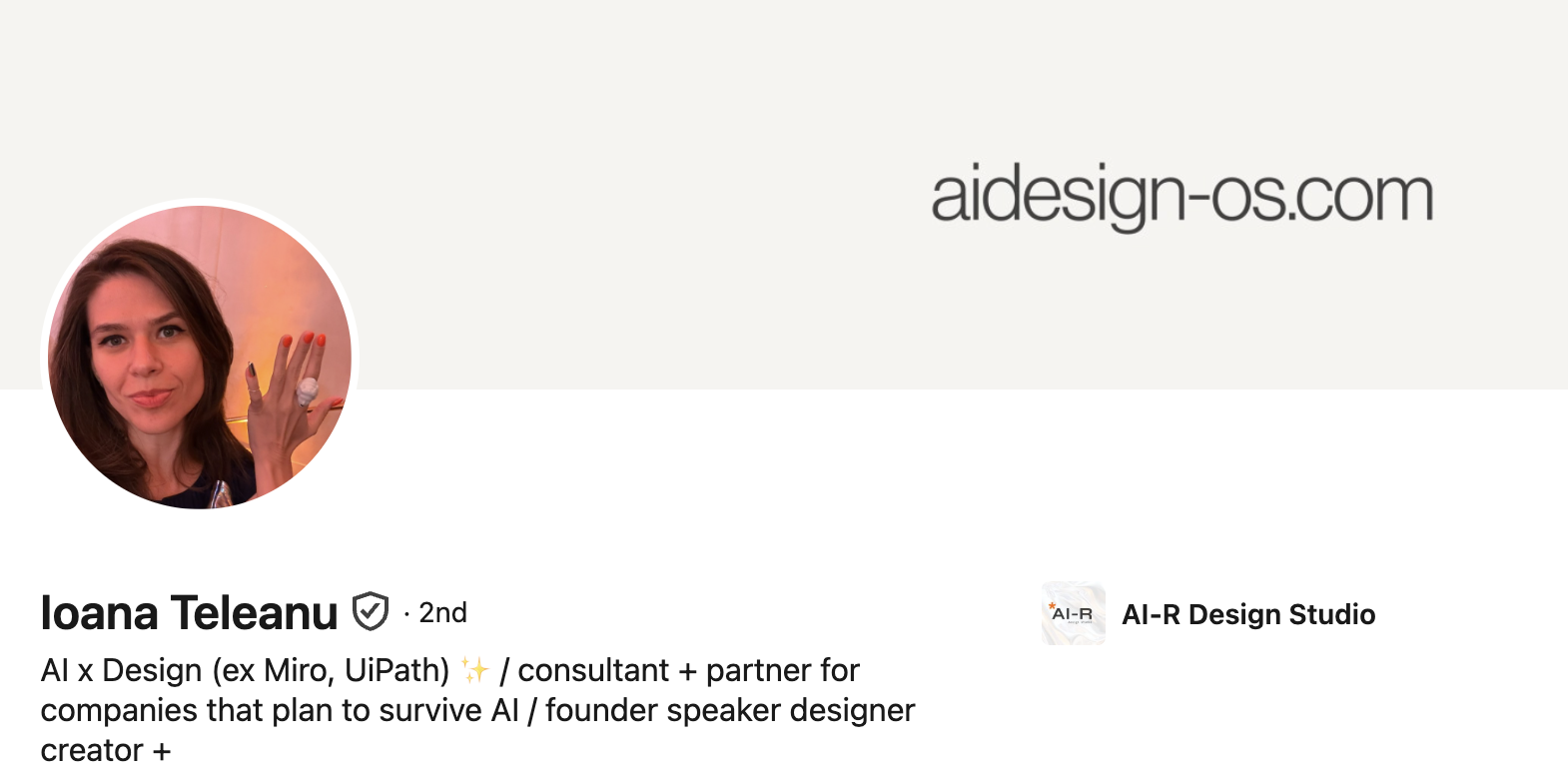
Ioana Teleanu
Years of experience: 12+
Primary focus: AI Product Design, AI UX Strategy, Consulting
Key services: AI Product Design, AI UX Consulting, Design Leadership, Speaking & Education
Location: Romania
For AI businesses where the design decisions are genuinely high-stakes — where the interface shapes how users relate to AI, how much they trust it, how they calibrate their own judgment against its outputs — Ioana is the most credentialed independent consultant on this list.
Clipboard AI at UiPath: Time Magazine Best Invention of 2023. First designer on Miro's AI team. US Design Patents for AI product work. Consulting clients include Anthropic, Framer, Adobe, Notion, ElevenLabs. Speaker at SXSW, TED AI, GitNation. Creator of the most-enrolled AI for Designers course on Interaction Design Foundation. 250K+ design community followers.
She runs AI-R Design Studio now, taking on AI business projects where the design challenge is serious enough to warrant the most experienced person in the room.
Kirill Lazarev
Years of experience: 10+
Primary focus: AI Digital Product Design, Startup Design
Key services: AI Product Design, UX Strategy, MVP Design, SaaS Design
Location: San Francisco
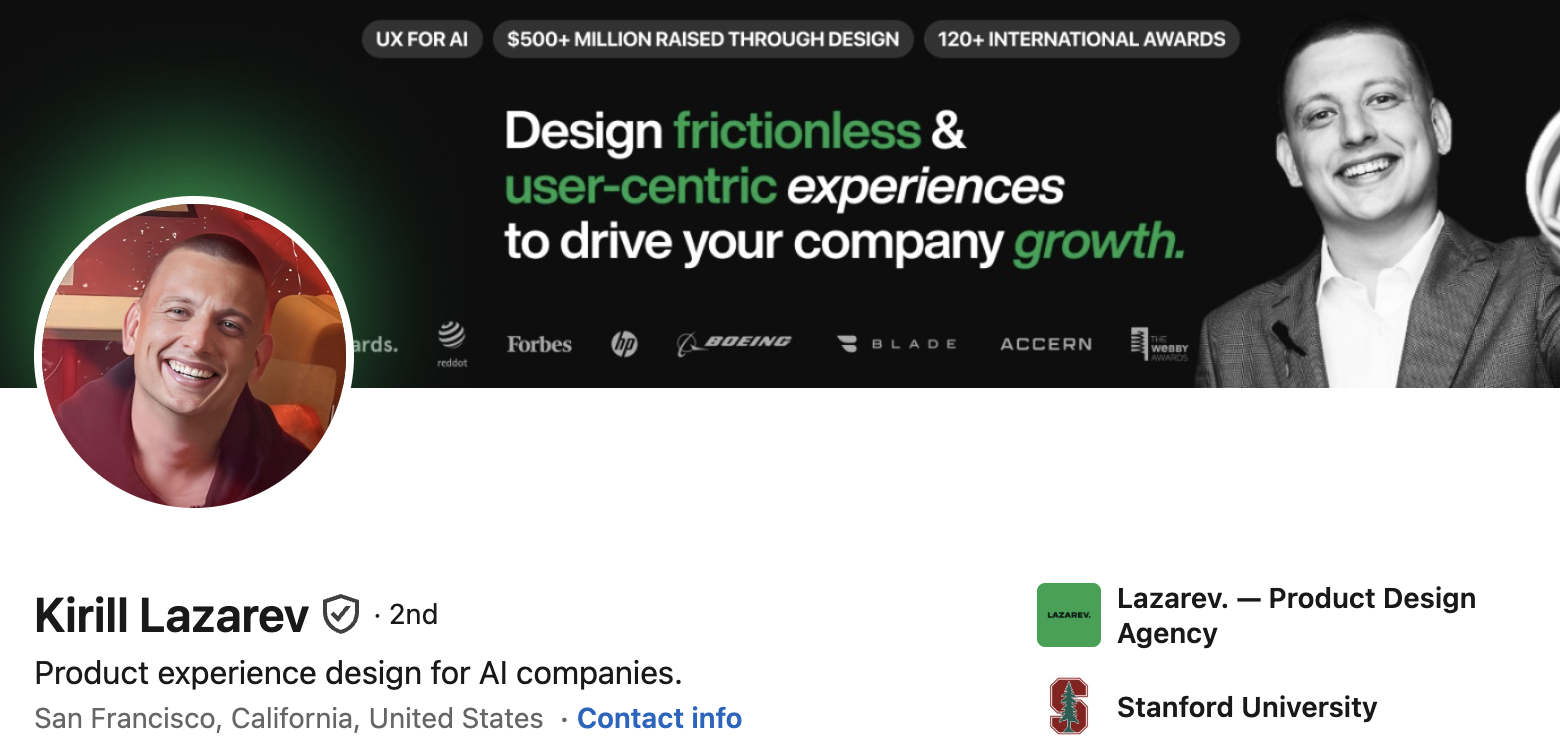
Kirill built Lazarev.Agency from a one-person operation into a 40+ person team with 120+ design awards and a track record of supporting clients in raising $500M. The agency has been doing AI product design since 2018. Based in San Francisco, Kirill is active in the AI startup and investor ecosystem — which means the agency understands what AI businesses need to show investors and enterprise buyers, not just users.
For AI businesses at the fundraising or go-to-market stage, that combination of design quality and commercial orientation is relevant. Five Webby Awards. Six Red Dot Awards. Work across fintech, healthcare, Web3, SaaS, and AI-native products.
Andrew Sapkowski
Years of experience: 6+
Primary focus: Product Design, AI UX, B2B SaaS
Key services: UI/UX Design, Product Design, Design Systems
Location: Ukraine
Andrew works on B2B SaaS and AI-enabled products at Cieden. His focus is the execution layer — taking the strategy and research through to high-fidelity design and design systems that development teams can actually build from. Part of the team actively working through AI UX patterns for the specific challenge of integrating AI into enterprise products without breaking existing user workflows.
For AI businesses that need a strong execution-level designer embedded in a team with genuine AI UX depth, Cieden's model — and Andrew's role within it — is worth understanding.
How to Choose an AI Designer for Your Project
Define what kind of AI design problem you actually have
AI business design challenges are not all the same. Building trust for a brand-new AI-native product is a different problem from adding AI features to an existing enterprise SaaS tool. Designing for a regulated healthcare AI is different from a consumer generative AI product. Get specific before you start evaluating candidates — the right designer depends almost entirely on what the actual problem is.
Look for ai design services that understand the business context, not just the interface
The best ai design services for AI businesses treat the product experience as a business development function. The design isn't just for users — it's for buyers, procurement teams, and investors who evaluate AI products through the quality of the experience before they evaluate the underlying technology. Designers who understand this build differently than those who treat it as a pure UX problem.
Match domain experience to your industry context
A designer with serious B2B SaaS AI experience understands enterprise buyer dynamics, multi-role user environments, and the organizational change management dimension of AI adoption. A designer with healthcare AI experience has worked through regulated context constraints and high-stakes decision support design. Domain experience is not decorative — it changes the quality of design decisions in ways that only show up under real-world conditions.
Evaluate how they think about AI credibility as a design problem
For AI businesses, credibility is a design output. Not just usability, not just aesthetics — the interface either makes the AI feel trustworthy and capable to the relevant audience, or it doesn't. Ask designers how they approach this specifically. What signals communicate AI reliability? How do they handle error states without undermining confidence? How do they make AI outputs feel appropriately authoritative without overstepping?
Ask ai designers how they design for skeptical users
Most users of AI business products didn't request AI. They're using it because their company bought it, their industry is adopting it, or their workflow now includes it. Designing for adoption when users start from skepticism or indifference is a specific skill. How ai designers approach this — progressive trust building, appropriate AI visibility, user control that feels real rather than performative — separates those who've worked with AI businesses from those who've designed for willing early adopters.
Consider whether you need project-based or ongoing design engagement
AI businesses keep shipping. The model changes, the product evolves, user behavior surfaces new design problems. A one-time engagement produces a snapshot. An ongoing design partnership grows with the product. Several designers on this list operate in ongoing embedded models specifically because AI business projects don't end at launch — they're continuous. Match the engagement structure to the actual lifecycle of your product.
Red Flags: What Weak AI Design Experience Looks Like
Most designers claiming AI experience are telling the truth about having touched an AI product at some point. That's a much lower bar than having developed judgment about how to design one well. A few patterns are worth listening for in a first conversation.
They describe AI design as a visual problem.
If the answer to "what's different about designing for AI" is mostly about chat bubbles, loading states, or a particular aesthetic, that's a sign the designer hasn't worked through the harder questions — what happens when the model is wrong, how much the interface should explain, what a user needs to see before an AI acts on their behalf. Those are behavioral and trust problems before they're visual ones. A designer who jumps straight to UI patterns without mentioning any of this usually hasn't had to solve it yet.
Every project story ends at launch.
AI products don't stabilize the way most software does — the model changes, outputs drift, new failure modes show up in production that never appeared in testing. A designer whose examples are all "we shipped it and it went well" hasn't necessarily worked through what happens in month four, when the model's behavior shifts and the interface built around its old behavior stops making sense. Ask what changed after launch, not just what shipped.
They can't name a specific moment they got the trust calibration wrong.
Everyone claims to design for trust. Few can point to a real case where they overcorrected — made the AI seem more confident than it should have, or so hedged and caveated that users stopped trusting outputs that were actually reliable. That failure mode is common enough that someone with real experience usually has a story. Its absence is more informative than its presence.
The portfolio is all consumer-facing, but your product is enterprise (or vice versa).
Designing trust for a consumer user trying a new AI tool for the first time and designing trust for a procurement team evaluating whether to approve an AI vendor are different problems with different stakeholders, different risk tolerances, and different sales cycles. A strong consumer AI portfolio doesn't automatically transfer, and the reverse is also true. Ask directly whether their relevant experience matches your buyer, not just your product category.
They treat "explainability" as a checkbox rather than a tradeoff.
Real AI interface design involves constant judgment calls about how much to explain, when explaining actually erodes trust instead of building it, and when an AI should just act versus ask first. A designer who talks about explainability as something you either "have" or "don't have" — rather than something you're constantly calibrating — likely hasn't had to make that call under real constraints.
None of these are disqualifying on their own. But a designer with genuine AI product experience will usually recognize every one of these patterns immediately, because they've lived through the version that went wrong before they got it right.
.avif)